Family Tides at Boardwalk Beach Resorts Panama City Beach
Built to attract tourists from all around the earth, the Palm Islands in Dubai are incredible feats of engineering. In this article, we'll briefly explore how they were built and examine some of their vital stats.
RELATED: PALM ISLANDS IN DUBAI
What are the Palm Islands in Dubai?
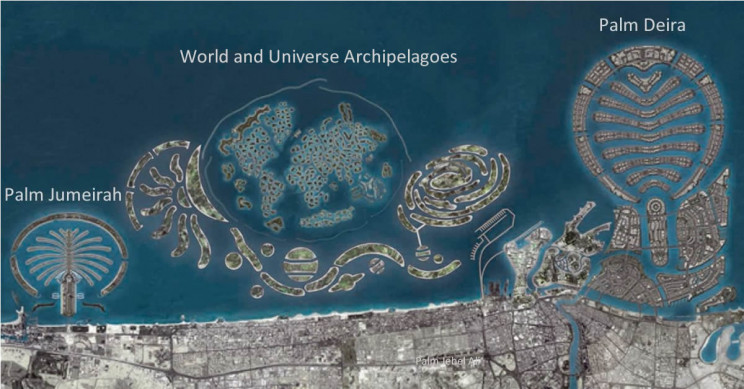
The Palm Islands in Dubai are three artificial islands built on the declension of Dubai in the United Arab Emirates. The iii islands, Palm Jumeirah, Deira Islands, and Palm Jebel Ali, are some of the most aggressive engineering projects always initiated.
Of the three, only Palm Jumeirah has actually been completed and, as the name suggests, takes the form of a big palm tree topped with a crescent.
Each island was planned to have residential, leisure and entertainment centers erected on them and they will add over 500 km of not-public beaches to the metropolis of Dubai once finished.
Palm Jumeirah stretches around 5 km into the Arabian Gulf and is cocky-styled as the "8th wonder of the earth". Just like the other Palm Islands, it is existence built by the Dubai government-owned developer Nakheel.
The other two islands savage foul of the 2008 financial crises and though the land reclamation had been completed, no further development has been planned for the near future for Palm Jebel Ali. Palm Deira, was supposed to be around 8 times bigger than Palm Jumeirah, merely plans for it have since been significantly scaled back.
Information technology is now planned to convert this project into a less ambitious four-island site. This 1,530-hectare development will eventually include hotels, residential towers, a sprawling mall, and a marina.
How were the Palm Islands built?
Dissimilar other largescale constructions, the islands' foundations were made from millions of tons of blasted rock, rather than concrete slabs. This rock was sourced from the nearby Hajar Mountains.
Hundreds of millions of cubic tonnes of sand were likewise dredged from the seafloor and used to class the upper parts of the new manmade archipelagoes.
Then much rock and sand was used in the islands' construction that it has been estimated that it could be used to build a 2-meter wide wall that could encircle the globe three times!
Palm Jumeirah island is protected from the ravages of the sea by an 11-km manmade breakwater that surrounds the isle in a crescent-shape. This besides helps protect the isle from seasonal 'shamal' winds that oft blow across the Gulf from Republic of iraq.
"A geotextile membrane, which stops the sand from washing away, was topped by a layer of one-ton rocks, followed past 2 more layers of rocks weighing up to 6 tons each.
A 100m-wide opening was added on each side of the crescent to allow water to circulate and prevent information technology [from] becoming stagnant. A 6m-broad boardwalk stretches the length of the crescent and is a summit spot for a sunset stroll." - Travel Zoo.
The shape of each isle was guided using how-do-you-do-tech GPS systems onboard each dredger to ensure pinpoint sand deployment accurateness. Vibro-compaction engineering was likewise used to set the reclaimed land once the isle shapes had been completed.
The Palm Jumeirah took effectually six years to consummate and the project cost$12 billion. Today each of the 17 fronds of the island is home to 1,500 beachfront mansions with a farther half dozen,000 apartments on its "trunk".
"Major hotels on the crescent includeAtlantis The Palm and the Waldorf Astoria, with brands such as Fairmont and Viceroy on the trunk. Resorts in the works include The Royal Atlantis, next to the existing Atlantis resort, and Palm 360, a two-tower resort connected past a 155m-long 'sky pool'." - Travel Zoo.
What was the purpose of the Palm Islands?
The main reason for the construction of the Palm Islands was to increase Dubai's tourism market by providing a i-of-a-kind tourist destination. This was seen as peculiarly of import to the UAE to be able to hedge against the predicted long-term turn down in project oil revenues as reservoirs ran out.
Each of the archipelagoes had been planned to be brimming with world-class hotels, upscale services, civilities, as well as many kilometers of private beaches for vacation goers and local residents.
Some other reason for the islands' construction was to provide prime number real estate for private individuals. Additionally, eastwardxclusive residential beachside villas and apartments, marinas, water theme parks, restaurants, shopping malls, sports facilities, and health spas were also planned for the islands.
7 takeaway facts nigh the Palm islands
i. Palm Jumeirah, the only completed island, consists of 17 branches and a central trunk surrounded past a crescent-shaped xi-km breakwater. The bogus archipelago is roughly 5-past-5 kilometers in dimension and has an surface area of roughly 800 football fields.
2. Palm Jumeirah likewise has an artificial reef that was partially created by sinking two F-100 Super Sabre jet fighters. Whether there is some symbolism in this or not is unknown, just information technology is a addicted favorite destination for scuba defined.
three. Over 12,000 Palm trees were planted on Palm Jumeirah alone. These were grown in a plant nursery in Jumeirah, Dubai.
4. "A vehicular tunnel connects the spine to the crescent, and a transit monorail runs about iii miles (4.8 km) from the mainland to the crescent through the spine and trunk. The crescent is 650 feet (200 meters) wide and about ten.v miles (17 km) long altogether. At least 1,380 acres (560 hectares) of new land were created inside an area about 3.i miles (five km) in bore." National Britannica.

5. Palm Jumeirah was the first of three such manmade archipelagoes planned. Of the other two, Palm Jebel Ali has since been mothballed and Palm Deira has been significantly scaled back.
half dozen. Millions of tons of blasted stone and dredged sand from the seafloor were used to repossess the land for the islands. This textile was compacted using vibro-compaction technology.
7. The islands were planned and built in a bid to increase tourism to Dubai. This was to deed as an insurance policy against the burnout of UAE's extensive oil reserves in the hereafter.
Source: https://interestingengineering.com/7-curious-facts-about-dubais-palm-islands
0 Response to "Family Tides at Boardwalk Beach Resorts Panama City Beach"
Post a Comment